Wednesday, November 28, 2012

Media Share


Advertising as Religion

 In the text “Advertising as Religion: The Dialectic of Technology and Magic,” Sut Jhaly states that Karl Marx’s predictions of society have proven to be true.  Marx believed that material items would corrupt human relationships as a result of capitalism and advertising.  In order for an item to thrive in capitalism, it needs to be advertised, promoted, and sold.  In today’s society, material items can make use feel a certain way about ourselves, interact with others based on the things we own, or interact with others through certain things that we own.  Although superficial, people can relate to others who own the same items or brands as them.  Jhally mentions older non-market societies and how people in those times people also had a connection with the goods that they used.  It seems as if it is natural for humans to connect with their physical belongings; however, in the older non-market societies people produced their goods themselves.  Therefore, their connection was more direct and intimate.  Today, there are so many products and brand names that advertisers have to compete with one another in order to have their product sold even if it means tricking the consumers.  Advertisers claim that the main purpose of advertising is to provide consumers with options in order to make the right choice in their purchase.  However, the real function, Jhally states, is to make people feel good and focus on what the public wants to hear.  It is true that that often times we don’t have enough time to look at every item on the shelf in close detail to make sure it is the best product, in which case advertising certainly stays in the back of our minds often times causing us to choose the brand name we have heard before.  Advertising allows people to justify the choices they make when choosing a particular brand because the ad proves that it does works or is worth it.  Jhally declares that it is similar to religion in the sense that people use religion to justify their choices as well.  Another similarity between the two is the act of worshiping.  In religion, people worship their own God or higher power and in a capitalist society, people worship their physical belongings.  This reminds me of an email my mom sent me:

Advertising as Religion


I found Jhally’s article, especially his ideas about Advertising as Religion really interesting. We’ve talked a lot about advertising creating an experience for consumers in order to make them feel like they need the product, and that “the function of advertising is to refill the emptied commodity with meaning”(221). In today’s world, where religion is often being replaced by other ideas, advertising can create that awe-inspiring vision for a person that needs to fill a void. Sometimes the consumer may not even know they have a void until they see an advertisement, but with proper marketing techniques the producers can trick the consumer into thinking they need to buy something to make their life better. This all reminds me of a documentary called “What Would Jesus Buy?” in which a famous activist who goes by the name of Reverend Billy, goes on a campaign to stop the “shopocolypse” that is world is facing. Reverend Billy uses religious themes to shock people into taking a step back and to question whether they really need a product, where it was made, under what conditions etc. Jhally brought in a quote by Jesuit scholar John Kavanaugh who argues, “advertising is part of a gospel based upon the commodity form –a world where people are identified through the things they consume as well as being dominated by them”(226). Today in a consumer-based world, advertising is only reinforcing the idea that people need what they are buying. People like Reverend Billy and his Church of Stop Shopping use the same techniques that advertisers use to sell products, sensationalizing etc., to try to dissuade people from over consuming. Below is the trailer to “What Would Jesus Buy?” it’s a pretty entertaining and interesting documentary. 

Tuesday, November 27, 2012

Advertising

There is no secret sex sells. We have observed the feminine and masculine side of advertising and how appealing the body can be to consumers. When advertising the human body it is nothing more than a sexual object to attract consumers eyes. Sexual advertising can be found in nearly any brand that advertises. In Advertising by Stole she wrote how, "Sigmund Freud's view of the human mind as irrational, easily manipulated, and driven by unconscious (mainly sexual) instincts and desires invited advertisers to apply psychological constructs to their commercial strategies" (615).  What I find interesting is that sex can be applied to anything and have no relevance to the product at hand. Carl's Jr. came to my mind immediately which led to me thinking of the oligopolistic advertising in the fast food industry. In my mind I group together 4 chains: McDonald's, Burger King, Jack-in-the-Box, and the infamous Carl's Jr. All 4 of these companies make and sell similar products. But what is interesting about the companies at hand is the different advertising schemes they implement to sell their product. Check out these different commercials from the fast food chains above.


http://www.youtube.com/watch?v=xu_bE7g2wqM

http://www.youtube.com/watch?v=PmrTDZy3f2M

http://www.youtube.com/watch?v=J11qUjHiGhs

http://www.youtube.com/watch?v=zf5i0O2PNS4

It's really interesting to see the different approaches they have to the market and who their target audiences are. Hope you enjoyed.

RAM:
http://www.youtube.com/watch?v=BmPj8S1R55w


FORD:
http://www.youtube.com/watch?v=SaE3UrE3uOU


CHEVY:
http://www.youtube.com/watch?v=XxFYYP8040A

'Tis the Season to be Conscious of Advertisements

One of the key points that Stole makes in his/her article was that without advertisements, we, as consumers, would not know which brand we should buy. Ads are essentially supposed to inform the consumer of the different products and of any differences that exist from competitor brands. Instead, Stole explains that companies try to differentiate themselves from other competitors by devising elaborate ad campaigns that creates a desire for the product.  An example that came to mind was paper towels. Why is Brawny better than Bounty or vice versa? They have the same qualities and price, yet Brawny is advertised as a burly, durable, and tough while Bounty is advertised as great for homes and families. Wait, what? Without the packaging and ads, the two brands are the same. Moving forward with how this is relevant to holidays, specifically Christmas, it has become evident that companies have used this holiday to tell that people’s loved ones NEED the newest iPhone for Christmas. What about the true meaning of Christmas? Advertisers have stripped away the actual meaning of Christmas and commercialized the holiday to conform to their constant drive for profit-making.
Corporate greed leads advertisements to deceive the consumers as seen in ads. From personal experience, online shopping can be generalized to be a modern loophole for false advertising. Whenever I shop and buy clothing, the model would make the shirt look really high quality and in a very nice color. The moment I get it in the mail, the shirt is cheap and looks ten shades uglier than what I saw in the picture that they advertised… not to mention that the shirt is a lot wider than it looked on the fairly thin model. With the introduction of the Tugwell bill and its reaction by advertisers, Inger Stole brings up an important point on the role and effect of advertisements for consumers. The Tugwell bill “empowered the FDA to prohibit ‘false advertising’ of any food, drug, or cosmetic. It defined any advertisement as false if it created a misleading impression ‘by ambiguity or inference’” (91). This is a response from the consumer movement that had their anxieties about the commercialized society that deceive consumers into buying ambiguously advertised products.
To tie these two ideas together, Christmas has become commercialized and we are being deceived that these invented traditions that advertisers have deployed are what we want. We are told what to buy for gifts and instead these ads are only reinforcing the status quo. The status quo is reproduced when ads create campaigns that targets a certain population but instills this desire of us and them.  These ads and the culture to buy things to gain social status is exactly what advertisers are trying to tap into. My takeaway on this article was that we should really question the advertisements that we are being bombarded by especially during this holiday season. Don’t get me wrong, I love the holiday season but being a conscious consumer doesn’t hurt.

Monday, November 26, 2012

Advertising and the Cola Wars

In Inger L. Stole's chapter "Advertising", she discusses the idea that in oligopolistic markets, advertising that gives consumers information by comparing products does not work if there are no differences between the dominant brands in a market (page 86). She writes, "To tell the truth about a product - that it costs the same as its competition and is basically identical in quality - would hardly develop brand loyalty or secure new users". Stole uses this fact to explain why modern advertising uses imagery, emotional claims, or irrelevant claims in advertising messages. The point, she argues, is to create a difference in consumers' minds even if there is little or no difference between the product and its direct competitors.

When I read this paragraph, I immediately thought of the ongoing advertising battle between the Pepsi and Coca-Cola soft drinks. Appropriately named the "Cola Wars", both brands have engaged in a campaign of television advertisements and marketing campaigns that target the other.


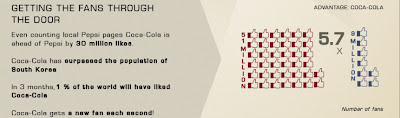
These fizzy, dark, sugary drinks are both extremely similar in taste and appearance, making them parity products that have no major differences between either of the two brands. Thus, the firms in those markets must spend more money of advertising to convince the public that they are in fact different. Annually, both brands spend billions of dollars on advertising around the globe. 
While Coca-Cola does not seem to directly attack Pepsi as obviously in their advertisements, the battle between the two brands of soda is well-known and continuously ongoing. Despite their differences, both soft drinks have become increasingly dependent on advertising to secure "brand loyalty" in order to sell their products (Stole 88). Consumer brand loyalty is especially illustrated through social media like Facebook page likes and comments. For example, Coca-Cola's Facebook page has 51 million likes versus Pepsi's 9 million likes. 


Despite these Facebook numbers, both companies have spend enormous amounts of time and money to conquer one of the toughest advertising strategies in Stole's chapter: creating a belief that their products are different despite being inherently equal.